
West of Ewing
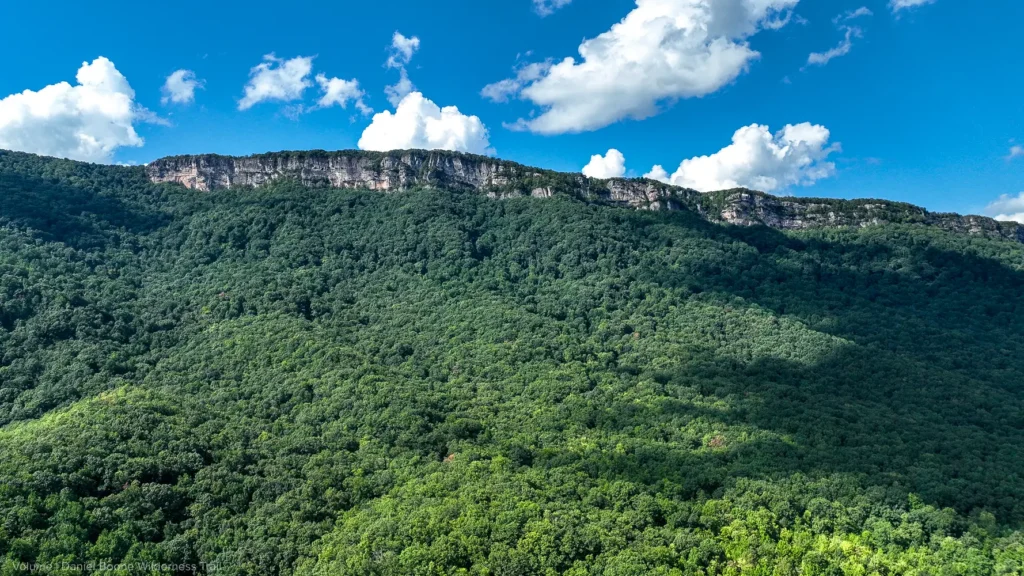
The white rock cliffs atop Cumberland Mountain to the right were among the most commonly mentioned geographic features recorded in the journals of the emigrants along the entire length of the Trail. The pioneers seemed to take them as a hallmark of the wonderful new land that they were claiming as their own.
The term Cumberland seemed to ring in their souls as the name of the port-of-entry into the Promised Land. The Cumberland Mountain guided them on their way until they reached Cumberland Gap, which was the gateway to Eden. From there they traveled across the Cumberland Valley to the Blue Grass. Indeed, Cumberland is the most common county name in the Appalachian region of the United States. It is no accident. The Duke of Cumberland was in command at the Battle of Culloden in Britain in 1746 when the Lowland Scots, with their English allies, massacred their ancient enemies, the Scots Highlanders. These emigrants along this Trail were primarily descendants of Lowland Scots who lived along the border between Scotland and England, and are the same group we tend to call the Scots-Irish. The Duke of Cumberland was their liberator, and Cumberland Gap was their gateway to the Promised Land.
Somewhere around the community of Ewing was located the little known Owen’s Station, which may have been built by William Owen.