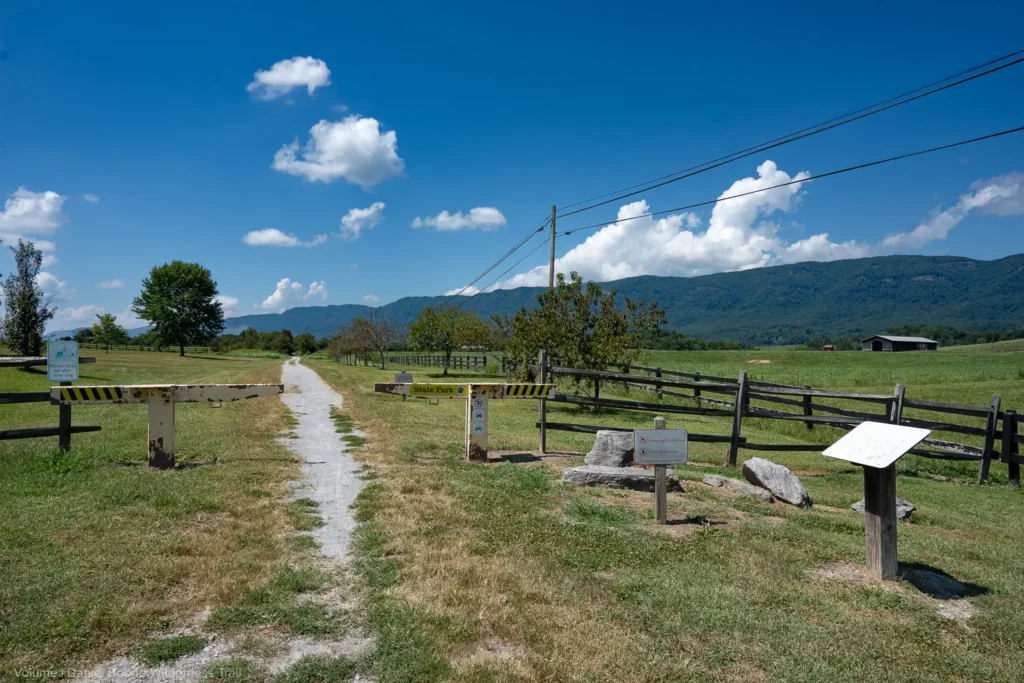
East End of Bike Trail
Here is the eastern end of a bike trail that follows the old rail bed of the Louisville and Nashville Railroad on westward toward Cumberland Gap. In this beautiful setting it is hard to imagine the horrors that occurred in this beautiful valley during the Great Cherokee War of 1776-1794. This terrible war was both the typical conflict between encroaching settlers and the region’s native inhabitants, but also very much a part of the American Revolution. From a local perspective it was also a civil war.
At the beginning of the Revolution the emigrants along the Trail were frequently former North Carolina Regulators and others of Scots-Irish background. These people had been allies of the English at Culloden, and during the Irish wars when the Border People had been transported to Ulster in Northern Ireland, the English had been their sustainers in the interminable conflicts with the native Irish. At the beginning of the Revolution many of the settlers had loyalist, or Tory, leanings.
The Cherokee had been allies of the Holston Militia during the recent Lord Dunmore’s War against the Shawnee. The settlers and the Cherokee were heavily intermarried. At the outbreak of the Revolution the British adopted a war policy of inciting the Indians along the frontier into war against the American settlers. The same colonial Indian agents that had established relationships with the Cherokee before the Revolution continued to work for the British and incited the Cherokee to war against the settlements and the Holston Militia. The Cherokee could not understand it. In their culture, people of one tribe did not make war on others of that same tribe. Many living in the settlements were their kin.
But the British Indian agents were persistent, and the King had genuinely tried to keep the settlers out of Indian land. And the British had trade goods. The Holston settlements were ignoring the treaties and were pouring new settlers into the heart of Cherokee country. So the settlers divided among themselves into Whig and Tory, and the Cherokee joined the Tories in attacking the Whigs. The result was that the Loyalist Tories were driven out; the remaining settlers became strongly antiBritish; the Cherokee nation was divided into those wanting peace with the settlers, and the Chickamauga war faction; and the Cherokee lost Kentucky and all of Tennessee west of the Mountains. Both sides suffered terribly. Though official peace came with the end of fighting in 1794, the conflict did not play itself out until the expulsion of all the Cherokee that could be found to Oklahoma Territory in 1838.