
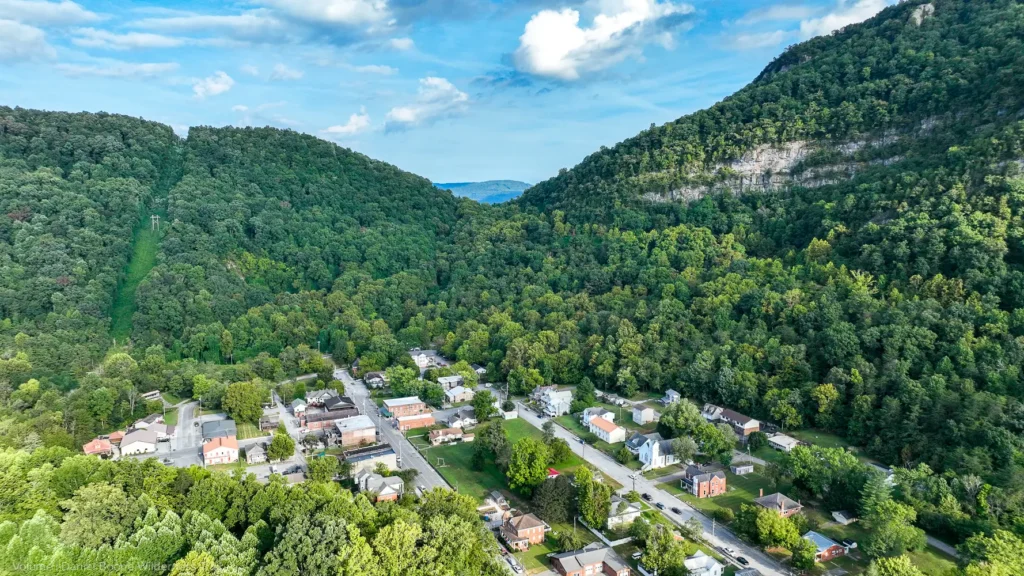
Cumberland Gap
One of the most significant of the several historic gaps or passes along routes of settlement in the United States, Cumberland Gap stands alone east of the Mississippi. Its location determined the route of travel of people from Georgia to New York; from Arkansas to Illinois. Only the Ohio River can compare with its significance as a route of migration from the Eastern Seaboard to the interior of the country.
The first European to have seen it was Gabriel Arthur. He was chief assistant to the Needham expedition sent out from Fort Henry at present Petersburg, Va in 1673 by General Abraham Wood, who was acting on behalf of the government of Virginia. They made it as far as Chota, capital of the Overhill Cherokee on the Little Tennessee River. Needham turned back to report to General Woods, but commanded the indentured servant Gabriel Arthur to remain. He was to learn the language of the Overhills. Needham would soon return for him.
Needham was murdered on his attempted return trip to Chota. Arthur was befriended by a chief, and was taken as a warrior to fight the Shawnee in Ohio. It is not clear if the war party passed through Cumberland Gap or not. Arthur was captured by the Shawnee, and later they placed him on the Great Warrior’s Path in Kentucky and gave him directions on how to get home. Certainly on this part of his journey he passed through Cumberland Gap. It was 1674, and he did make it home to Petersburg.
In 1750 Dr. Thomas Walker lead an expedition through the Gap to as far west as Pineville. He was exploring on behalf of the Loyal Land Company, which owned the land in this region. He left an excellent journal of his adventure. In 1761 the party of long hunters lead by Elisha Walden changed the name of the Gap from Cave Gap to Cumberland Gap in honor of their hero of the recent Battle of Culloden. Incidentally, it was the Walden party that found the name of Ambrose Powell carved on beech trees along the course of a river known till then as the Bear Grass, and changed its name to the Powell River. Powell had been a member of the Walker party. It was in 1769 that Daniel Boone made his first of many passages through the Gap that would forevermore be associated with his name.