

The Long Hunter by Emory L. Hamilton, p. 29, The Mountain Empire Genealogical Quarterly, Spring l984.
The Long Hunters of Southwest Virginia
The Long Hunter was peculiar to Southwest Virginia, and nowhere else on any frontier did such hunts ever originate. True, there were hunters and groups of hunters on all frontiers in pioneer days, but they were never organized and publicized as the long hunts which originated on the Virginia frontier.
Most, if not all, of the long hunts originated on the Holston in the vicinity of present-day Chilhowie, but were made up of hunters who lived on both the Clinch and Holston rivers. The idea of this manuscript is to prove, beyond a reasonable doubt, that these long hunters were native to the area and were landowners or residents along the waters of these two rivers.
Perhaps no group in history who contributed so much to the knowledge of the topography of our country has been so nearly completely bypassed by historians as have the Long Hunters of the late colonial days.
In almost every instance when the pioneer settler moved toward the extreme frontier, he had long since been preceded by the Long Hunter. When the first settlers were arriving at Wolf Hills (Abingdon) and Cassell’s Woods in 1768 and 1769, the Long Hunters had long ago bypassed these points and were then hunting far away in the Ohio and Cumberland river basins of Kentucky and western Tennessee.
Most of the rivers and streams, gaps, salt licks, mountains, and valleys had long ago been named by these hunters. When the first settlers arrived, they, in most cases, adopted the names bestowed by the Long Hunters on natural landmarks, with very few changes, and we are still using most of them after a lapse of nearly two centuries.
Dr. Thomas Walker, on his trip to the Ohio, entered in his journal on April 9, 1750, this statement:
“We traveled to a river, which I supposed to be that which hunters call Clinch’s River, from one Clinch, a hunter who first found it.”
This entry was made almost twenty years before a settlement was made on the Clinch River and leaves little doubt as to how the river got its name.
Hunters, Explorers, and Frontiersmen
In the annals of American history there is no braver lot than these early hunters. Not only did they endure the rigorous winters in crude shelters, but also the dangers of sickness, privation, exposure, hunting accidents, and the very real and ever-present danger of being killed by Native warriors.
They were especially disliked by the Native people, who looked upon them as robbers of their hunting grounds — which they truly were — and also as forerunners of the ever-spreading, land-clearing, soil-tilling settler.
Just why was this particular group of men given to hunting instead of tilling the soil as most settlers did?
Perhaps there are three answers to this question.
First was the spirit of adventure born in some people which they are unable to quell. Among these were James Dysart and Castleton Brooks, who were quite well-to-do, as well as Colonel James Knox, who is referred to as the leader of the Long Hunters and who later became very wealthy.
Second, there were those who enjoyed, above all else, the spirit of the hunt. Among them were Elisha Wallen, William Carr, Isaac Bledsoe, and others who, all their lives, were hunters and little else.
The last answer, but certainly not the least, was the profit derived from these hunts. It was not uncommon for a hunter to realize sixteen to seventeen hundred dollars for his season’s take, and this was far in excess of what he could earn in almost any other lucrative endeavor.
The hides and pelts were sold along the coast, where animals were no longer plentiful, and in England for making leather, especially buffalo skins. The British market was lost at the outbreak of the Revolutionary War, and the long hunts were never again pursued after the war began.
The Skills of a Long Hunter
The Long Hunter today might be called a scientist, naturalist, explorer, or some other high-sounding name, for he had to be master of many arts.
He knew the sky and what a sunset foretold. He knew the wind and could tell by its smell whether the weather was dry or moist, and could wet his finger and determine in which direction it was blowing. He could, in numerous ways, tell the seasons, predict the weather, and use the stars to determine time and direction.
He knew the plants and where they grew. By feeling the moss and shaggy bark of a tree, he could determine north and find his direction by night. He knew the medicinal properties of plants and how to treat his wounds and ailments with them.
He knew his rifle — how to use it, repair it, and, in some instances, even how to make one. He knew the use of the hunting and skinning knife, the tomahawk, and other tools and weapons of the hunt.
He knew the habits of animals and birds and was able to distinguish their true calls from imitations. His training came from the natural world around him. Even the toys of his childhood were often imitations of the tools of his future life.
The Long Hunters usually went out in October and returned in the latter part of March or early April. Their winter’s take consisted of both fur pelts and hides, especially buffalo hides.
Buffalo were sometimes wantonly slaughtered for their hides alone, with the carcasses left to be devoured by animals and vultures. There are recorded events where hundreds — and a few times thousands — were slain. Certainly Native people were justified in their feeling that their hunting grounds were being robbed.
John Redd’s Accounts of the Long Hunters
Some of the best descriptions of the Long Hunters were left to us by John Redd, who knew many of them intimately, both in his native Pittsylvania County and in Powell Valley when he came to Martin’s Station in 1775.
According to Redd, the Long Hunters seldom hunted in parties larger than two or three men. Their reasons were twofold: larger parties were more apt to scare game away, and Native people were less likely to become suspicious of a small group hunting on their lands. Smaller parties were also less likely to be discovered.
Redd tells an interesting story about Powell Valley that was related to him by the Long Hunter William Carr.
“Twelve miles south of Martin’s Station on Powell River, there was a very rich piece of bottom land called ‘Rob Camp.’ In this there was the remains of an old hunting camp from which the land took its name.”
Some five years before Martin’s Station was settled, three men, with two horses each and their traps, guns, and other necessary equipment for a long hunt, settled in this bottomland. They built a camp and spent the fall, winter, and part of the spring there hunting.
At that time, peace existed between the settlers and Native people. The hunters were very successful in killing game and initially lived in harmony with the Native people, who frequently visited the hunters.
This continued until spring, when the hunters concluded that they had as much fur and skins as they could conveniently carry home. They packed their horses and were preparing to leave with the earnings of their successful hunt when twelve or fifteen Native men arrived.
They took possession of the hunters’ horses, furs, guns, and virtually everything they had. In exchange, they gave the hunters three old guns and told them that the land on which they were hunting belonged to the Native people — as did the game. They spared the hunters’ lives but cautioned them never to return.
An Abandoned Camp in Powell Valley
Redd tells of another camp he saw in Powell Valley. Recalling his journey to settle Martin’s Station in January 1775, he wrote that near the junction of Wallen’s Creek and Powell River they found the remains of an old hunting camp.
In front of the camp lay the bleached bones of two men. They were said to be the remains of two hunters who had gone out in the fall of 1773 and never returned.
In another letter to Dr. Lyman C. Draper, Redd described the site:
“The remains of the camp I saw in Powell Valley were on its north side; and as well as my memory serves me, were within forty or fifty yards of the mouth of Wallen’s Creek at the ford of Powell’s River. The camp was built beside a large limestone rock which served for the back of the camp.”
Redd suggested this might possibly have been the camp used by Boone’s party.
His reference to “Boone’s war party” must be a reference to the spot where Daniel Boone’s party camped in 1773 to await the party coming to join them from Castlewood. That party was ambushed near the head of Wallen’s Creek on October 10, 1773.
The location described by Redd also fits the general location of Elisha Wallen’s hunting camp of 1761.
The Long Hunter’s Camp
Redd says the Long Hunters set out with two pack horses each, a large supply of powder and lead, a small hand vise and bellows, a screw plate, and files for repairing their rifles. While he makes no mention of it, they also carried supplies of flour and bread.
On their way out they could carry considerable supplies because each hunter had two pack horses.
The Long Hunters often went out together in large parties, built a station camp, and then fanned out in twos and threes to range and hunt over large areas.
The first known station camp established in Powell Valley was that of Elisha Wallen in 1761. It is thought that his party consisted of eighteen or nineteen men, but since no complete list has been preserved, only a few are known with certainty to have been members.
Wallen’s station camp, established at the mouth of Wallen’s Creek, was probably like other station camps. It was built of poles, sometimes only eight or ten feet long, and covered with puncheons or bark. It had walls on three sides with the front open, along which a fire was built for warmth.
Upright poles were set up, often with a forked pole driven into the ground and a cross pole on which bark or puncheons were laid, sloping toward the back so melting snow or rain would drain away from the fire.
This type of shelter was known as a half-faced camp.
At other times, an exceptionally large fallen tree or rock was used as the back wall of the shelter.
Some of Wallen’s party are said to have seen the eleven-year-old carving of the name Powell and consequently named the valley, river, and mountain. Ambrose Powell had been a member of Dr. Thomas Walker’s exploring party of 1750.
Elisha Wallen
Redd says that when he knew Wallen on Smith’s River in Pittsylvania County in 1774, Wallen was about forty years old and had already been a Long Hunter for many years.
He usually hunted on a range of mountains lying east of Powell Valley, and from Wallen the mountain took its name.
Wallen described the ridge and surrounding country on which he hunted as abounding in almost every known species of game. The animals and birds had been intruded upon so seldom that they initially did not fear his presence, but soon learned to flee from him.
Wallen, along with the Blevins and Cox families, who were connected by marriage, lived on Smith’s River in Pittsylvania County in 1774.
Redd later wrote that Wallen moved to Tennessee, then Kentucky, and eventually Missouri. This account is supported by a letter written to Dr. Draper by F. A. Wallen, a nephew of Elisha, from Livingston County, Missouri, on October 15, 1853:
“He [Elisha] moved from Va. to Tenn., thence to Ky., thence to Washington Co., Mo. at a very early date.”
That Elisha Wallen lived for some time in Powell Valley near Martin’s Station is further supported by a letter from Colonel William Martin, son of General Joseph Martin, who built Martin’s Station.
Martin recalled going on hunting trips with Wallen, who lived near his father’s station in Powell Valley. He said Wallen told him about traveling back and forth to Pittsylvania County, helping Colonel William Byrd establish Fort Chiswell in 1761, being at Fort Loudoun, and building a fort at Long Island of the Holston.
Wallen’s Hunting Party of 1761
Some members of Wallen’s 1761 party were known to hunt as far away as the Cumberland River in western Tennessee.
Among those believed to have been in the party, besides Wallen, were:
- Jack Blevins
- William Blevins
- Charles Cox
- William Newman
- William Pittman
- Henry Scaggs
- Uriah Stone
- Michael Stoner
- James Harrod
- William Carr
At this time, William Pittman was in his early twenties, six feet tall, and described as a man of fine appearance.
Pittman and Scaggs
John Redd recalled that in the latter part of February 1776, Pittman and Scaggs came to Martin’s Station in Powell Valley.
They were returning from a long hunt they had taken in the “Brush” on the northwest side of Cumberland Mountain. They returned earlier than usual because they had seen a great smoke some distance away, which they believed to be Native “ring-hunting,” as well as tracks through the woods where they were hunting.
They therefore set out for home and spent eight to ten days at Martin’s Station.
While there, they showed the settlers some silver-colored ore they claimed to have found on top of a small hill in their hunting grounds.
According to Redd, snow had fallen twelve to eighteen inches deep. Scaggs and Pittman went out to kill game and noticed that one particular hilltop had no snow, even though all of the surrounding hills were covered.
They climbed the hill to investigate and discovered that its summit was covered with a very heavy ore. Each put some of the material into his shot bag and returned to camp.
Using their hand bellows and thick oak bark, they attempted to melt some of the ore and believed it to contain silver. They carried both the extracted material and some of the ore back to Martin’s Station.
Redd wrote:
“Scaggs & Pittman were said to be men of a very high sense of honor and very great truth. By the next fall the war with the Indians broke out and they went no more on their long hunts.”
Henry Scaggs
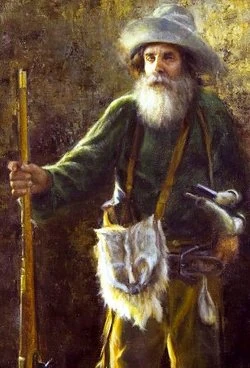
Henry Scaggs eventually left the area and moved into Kentucky. He died on Pittman’s Creek in Taylor County, Kentucky, around 1808 or 1809, reportedly more than eighty years old.
Collins, in his History of Kentucky, described him as:
“Six feet tall, dark skinned, bony, bold, enterprising and fearless.”
Scaggs and his brother were noted hunters. Scaggs Creek in Rockcastle County, Kentucky, took its name from him.
In 1779, Henry Scaggs was living on the Clinch. He had been hunting for twenty years on the other side of the mountain, and that fall he set out with a party of more than twenty men, extra pack horses, and his young son.
In Powell Valley, the party was attacked by Native warriors. No hunters were killed, but eleven of their horses were taken.
All of the hunters turned back except Scaggs, his son, and a man remembered by the name of Sinclair, probably Charles Sinclair of New River.
Scaggs’ young son became sick and died during the trip. Because of the severe winter of 1779–80, the ground was frozen so hard that Scaggs reportedly had to bury him in a hollow tree.
William Carr
Of William Carr, relatively little is known beyond what survives in the reminiscences of John Redd.
Redd wrote:
“He was raised in Albemarle Co., Va., and at a very early age removed to the frontier. In 1775 I became acquainted with him in Powell’s Valley. He lived on the frontier for twenty years or more and had spent the whole time hunting.”
Carr hunted in Kentucky beyond the Cumberland Mountains, to the right of Cumberland Gap, in an area called “the Brush.” He routinely returned with his horses laden with furs and skins.
Redd described Carr as the most venturesome hunter he ever knew. He frequently went on hunting expeditions alone. Even after the outbreak of war in 1776, when few men dared to make long hunts, Carr determined to undertake another.
Records concerning Carr are complicated by references to both William Carr and William Kerr, and it is unclear whether they were the same person.
A land suit in Augusta Superior Court in 1809 contains testimony from Agnes Fugate Mahan, widow of Francis Fugate, who stated that in 1771 her husband purchased land on Moccasin Creek from William Carr, whom she described as “a Negro man of color.”
Another witness, John Montgomery, said Carr was believed to be a near relation of General Joseph Martin.
Redd also left an account of Carr’s background, describing him as a dark-complexioned man who had been sent to the frontier at about eighteen years old with a horse, gun, and money.
When Redd met him at Martin’s Station in 1775, Carr was about forty years old and had lived on the frontier for approximately twenty years.
Redd wrote:
“Notwithstanding his color he was treated with as much respect as any white man. Few men possessed a more high sense of honor and true bravery than he did.”
He described Carr as intelligent, cheerful, strong, and “the very life of any company he was in.”
Uriah Stone
Another Long Hunter who spent considerable time in the Clinch region was Uriah Stone.
Evidence suggests Stone made improvements on land in several places where he hunted, possibly in hopes of later selling his claims.
In a land suit filed in Augusta County Superior Court in 1807, James Maxwell recalled traveling from Botetourt County to present-day Tazewell County in 1772 to make a settlement.
Maxwell and Samuel Walker discovered the foundations of a cabin, split rails, and deadened trees. That night they encountered a party of hunters that included Uriah Stone, who claimed to have made the improvements. Maxwell purchased the claim from him.
Another witness, Lawrence Murray, recalled being at Uriah Stone’s cabin in Wright’s Valley in 1774.
Stone also traveled into Middle Tennessee. In 1765–66, James Smith of Pennsylvania joined Joshua Horton, William Baker, Uriah Stone, and another James Smith on a journey west from the Holston country.
Stone returned to Middle Tennessee in 1767 and made an improvement on a claim at a place known as Stoner’s Lick on the east side of Stone’s River.
Michael Stoner
Michael Stoner, whose name is given in the manuscript as George Michael Holsteiner, was another important Long Hunter.
Along with Isaac Bledsoe, Gasper Mansker, John Montgomery, and Joseph Drake, Stoner was on the Cumberland by 1767. They are said to have maintained a station camp in 1768 on what became Station Camp Creek in Middle Tennessee.
A group of hunters from South Carolina who were on the Cumberland in 1767 mentioned meeting James Harrod and Michael Stoner on Stone’s River.
This was the same Michael Stoner who was at Castlewood and traveled with Daniel Boone in 1774 to Kentucky to warn surveying parties about danger shortly before the outbreak of Dunmore’s War.
On June 22, 1774, Colonel William Christian wrote Colonel William Preston while attempting to find someone capable of making the journey. Joseph Drake was considered because, as a Long Hunter, he was well acquainted with Kentucky.
Preston subsequently wrote Captain William Russell at Castlewood.
On June 26, Russell replied:
“I have engaged to start immediately, on the occasion, two of the best hands I could think of, Daniel Boone and Michael Stoner, who have engaged to search the country as low as the Falls [Louisville], and to return by way of Gasper’s Lick on Cumberland, and through Cumberland Gap.”
Stoner later went to Kentucky with Boone when Boone made his settlement at Boonesborough. He was also a member of Boone’s road-cutting party through Cumberland Gap.
Born about 1748, Stoner was still alive in 1801 when he made a deposition in Wayne County, Kentucky.
William Crabtree and James Aldridge
Two other Long Hunters associated with Powell Valley were William Crabtree and James Aldridge, both of whom may have been members of Wallen’s hunting party of 1761.
John Redd wrote:
“I have seen them both frequently, but know nothing of interest connected with their long hunts.”
William Crabtree was described as more of an Indian scout and hunter than a farmer — a true backwoodsman, tall and slender, with slightly red hair.
The Crabtrees were a numerous family living along the Holston, making it difficult to determine which William Crabtree was the Long Hunter.
Redd recalled Crabtree living on the Watauga in 1777, not far above its junction with the Holston, and estimated that he was about thirty years old.
Little information survives concerning James Aldridge. Some writers placed him on the New River, while Redd said he lived near the Crabtrees on the Holston.
Aldridge was described as about thirty years old, dark-haired, heavily built, stoop-shouldered, and possessing a sprightly mind.
Humberson Lyon
Humberson Lyon was another Long Hunter who hunted early on the Cumberland.
He was a brother-in-law of William Crabtree, having married Crabtree’s sister Hannah.
Lyon’s will was presented in Washington County, Virginia, court on March 16, 1784. His estate was left to his wife; his sons William, James, Stephen, and Jacob; and his daughter Susanna.
Humberson Lyon served as a juror in Fincastle County in 1773 and was recommended as a captain in the Washington County, Virginia, militia on October 9, 1780.
The Great Long Hunt of 1769
In 1769, a party of approximately forty hunters, led by James Knox, spent more than a year in the Cumberland country.
Many conflicting accounts of this hunt have been written, in large part because the original party divided into several smaller groups that traveled in different directions.
There is general agreement that they traveled together over the Hunters’ Trail to Flat Lick, near Stinking Creek, about eight miles north and slightly west of Cumberland Ford.
Many of the Long Hunters already mentioned were associated with this hunt. Others included:
- Anthony Bledsoe
- Abraham Bledsoe
- Isaac Bledsoe
- John Baker
- Thomas Gordon
- Jacob Harmon
- Castleton Brooks
- John Montgomery
- James Dysart
- Humphrey Hogan
- David Lynch
- William Lynch
- Christopher Stoph
- William Allen
- Joseph Brown
- Ned Cowan
The Bledsoe Brothers
The Bledsoe brothers — Anthony, Abraham, and Isaac — were described as tall men of fair complexion and English ancestry. Their parents had come from England to Culpeper County, Virginia.
After their mother’s death, they left home and came to the New River country around 1767.
Anthony, the eldest, married Mary, daughter of Thomas Ramsey, a noted Indian fighter who had been active during the French and Indian War.
Abraham Bledsoe became a professional hunter, while Isaac and Anthony became increasingly interested in land. Both eventually settled in Middle Tennessee.
Isaac Bledsoe served as a captain in the Cherokee campaign of 1776. The manuscript places his Southwest Virginia home along what is now Highway 58 between Bristol and Gate City.
The Route of the Long Hunters
A particularly valuable description of the Long Hunters’ route survives in a letter in the Draper Collection written by General William Hall of Tennessee to Dr. Draper on July 21, 1845.
Hall wrote that the Long Hunters principally resided in the upper country of Virginia and North Carolina, particularly along the New River and Holston River.
When preparing for a long hunt, they gathered near the head of the Holston, close to present-day Abingdon.
From there, they traveled west through Powell Valley and crossed Cumberland Mountain. They crossed the Cumberland River and continued toward the head of the Green River, through the Barrens, and across Big Barren River at the mouth of Drake’s Creek.
They then traveled up Drake’s Creek and crossed the ridge dividing the waters of the Ohio River from those of the Cumberland.
After crossing the ridge, the hunters traveled down either Bledsoe’s Creek or Station Camp Creek to the Cumberland River, where they spread out across the country to begin their hunt.
Hall named several prominent members of these expeditions, including:
- Colonel Isaac Bledsoe
- Colonel John Montgomery
- Colonel Gasper Mansker
- Henry Scaggs
- Obediah Terrell
- Joseph and Ephraim Drake
Bledsoe’s Lick and Mansker’s Lick
According to Hall, the hunters came down Station Camp Creek until they encountered a large and heavily traveled buffalo path.
They established their station camp on a bluff beside the path.
Colonel Isaac Bledsoe and Colonel Gasper Mansker reasoned that such a heavily traveled buffalo trail must lead to salt or sulphur licks.
They agreed to investigate in opposite directions the following morning. Bledsoe followed the northern end of the trail, while Mansker followed the southern.
Both were successful.
One discovered what became known as Bledsoe’s Lick, approximately thirteen miles away. The other discovered Mansker’s Lick, about twelve miles distant.
They returned to camp that night and reported their discoveries.
Bledsoe later described approaching the lick and encountering extraordinary numbers of buffalo. About two miles from the lick, the animals were reportedly so crowded along the path that his horse could scarcely make its way through them.
When he reached the bend of the creek at the lick, the surrounding flat — approximately one hundred acres — appeared to be covered with buffalo.
He described them not merely in the hundreds, but in the thousands.
The Buffalo Country
The sulphur springs occupied an area roughly two hundred yards across. Generations of buffalo had licked away the soil several feet deep, and about a dozen sulphur springs issued from within the area.
Bledsoe said the buffalo were so numerous that he was afraid to dismount for fear of being run over.
The animals showed little concern at the sight of Bledsoe and his horse. Only when the wind carried his scent toward them did they break and run in great herds.
The abundance would not last.
According to the account, a French hunter named Demunbreun traveled up the Cumberland River with a party of French hunters and killed enough buffalo around Bledsoe’s Lick to load their boat with tallow and buffalo tongues.
When Bledsoe and the Long Hunters later returned, the cane had grown so thick in the surrounding woods that they initially thought they had come to the wrong place.
At the lick, however, they found evidence of what had happened.
Bledsoe reportedly said that a person could walk for several hundred yards around the lick — and even within it — on buffalo bones.
Timothe Demunbreun
The Frenchman identified in the account as Denumbre was Timothe Demunbreun.
Williams, in Dawn of Tennessee History, wrote that Long Hunters in approximately 1766 or 1767 observed a hut or trading post on the bluff near French Lick, apparently belonging to Demunbreun, who had arrived by boat and begun trading with Native people and hunters.
Williams further identified him as Jacques Timothe Boucher de Montbrun, a descendant of Pierre Boucher, one of the prominent early figures of French Canada.
Demunbreun and his family reportedly lived for a time in a cave on the banks of the Cumberland River between the mouth of Mill Creek and Stone’s River.
His presence provides another link between the Long Hunters, Native trade networks, French activity, and the emerging settlements along the Cumberland — a landscape that these hunters had begun exploring years before permanent European-American settlement reached it.