
Netherland Inn – (Long Island)
Long Island on the Holston, or Hogohegee River was the sacred treaty ground to the Cherokee. It is the western terminus of the Reedy Creek Road, which carried the Great Warriors’ Path from Bristol to Kingsport, and is first mentioned in 1749 when Dr. Thomas Walker met Samuel Stalnaker on this trail. The first real road to Long Island was the Island Road, and was built as a military road in 1761 by the Virginia Militia under Major Andrew Lewis and Col. William Byrd from Fort Chiswell in present Wythe County, Va. This construction was part of the unsuccessful effort to relieve the Cherokee’s siege of the South Carolina Militia at Fort Loudon, located on the Little Tennessee River southeast of Knoxville.
The Cherokee were the most powerful of the Indian tribes of the Southeastern United States, and at the peak of their power could field 6,000 warriors. The tribe was divided into three linguistic and regional groups; the Southern, Middle, and the Overhills, who lived in East Tennessee.
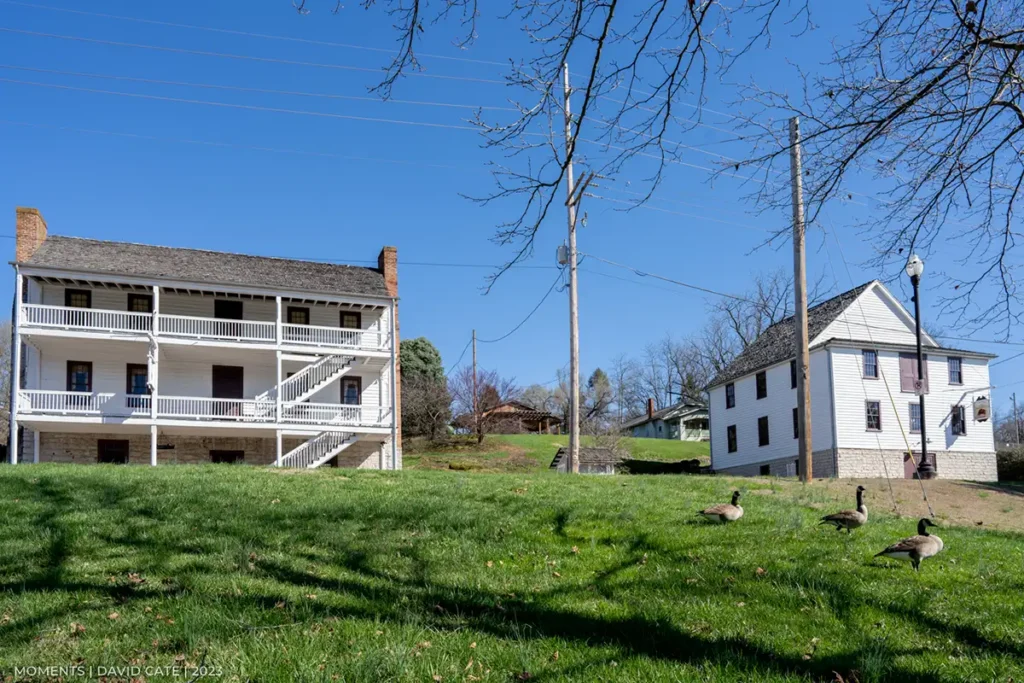
The Hogohegee came to be the boundary between the land in Southwest Virginia which was in dispute between the Iroquois and the Cherokee. The Netherland Inn, in whose parking lot you are parked, was built at a later date on the road out of Virginia as it headed deep into the land of the Overhills.
It was to this sacred treaty ground that Virginia sent its Agent to the Cherokee, General Joseph Martin, during the Revolutionary War, to negotiate and to trade with the Overhills. He lived here with Betsy Ward, his Cherokee wife for years, and raised a family. Betsy was the daughter of the most prominent woman in the Cherokee nation, Nancy Ward, who was the daughter of Chief Oconostota and niece of Emperor Attakullakulla, or Little Carpenter, who was the father of Dragging Canoe.
You can gain access to Long Island by parking at the Netherland Inn and by crossing the road to the Greenbelt. Go east on the Greenbelt walkway to the swinging bridge, and cross it to a monument erected by the Cherokee on land ceded to them in commemoration of the United States Bicentennial. The stone in the monument was brought here from their Qualla Reservation at Cherokee, North Carolina.