
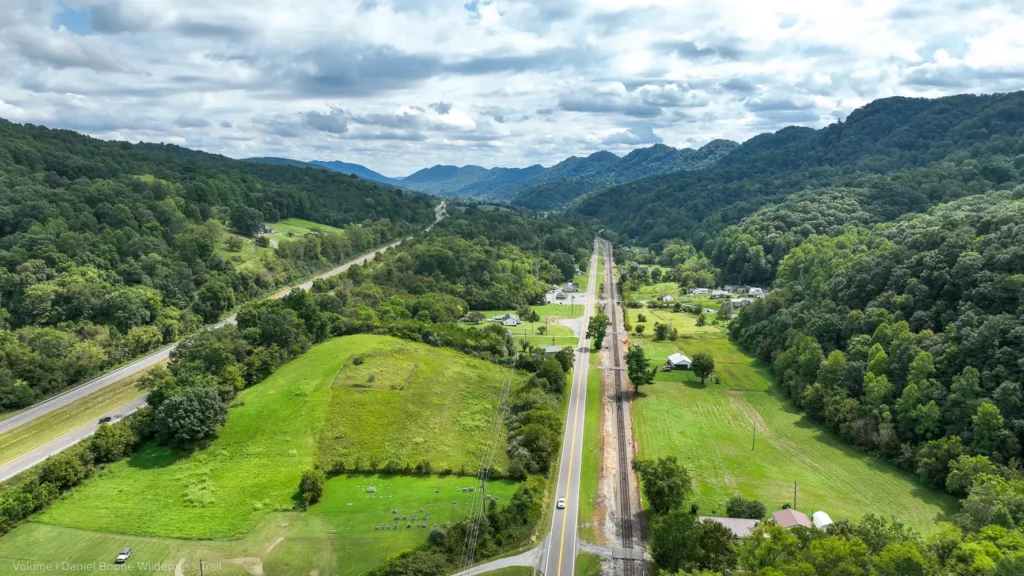
Daniel Boone, Va.
This railroad yard and the community that has sprung up around it is the only place in Virginia named after Daniel Boone. The road that you are traveling on is the paved Daniel Boone Wilderness Trail. Traditionally he drank out of a spring here.
Boone was born in 1734 near Reading, Pennsylvania. As a youth he and his family moved to the Yadkin Valley of North Carolina. He served as a teamster with the colonial troops at Braddock’s Defeat in the French and Indian War. He wandered the continent, having gone to Florida and to the Yellowstone Country, and much of the land in between.
While living in the Yadkin he began to take “long hunts” in the Abingdon to Johnson City area, and from there on into Kentucky in 1767. That year he named the Hogohegee or Holston River the “Indian River”, a name that it carried on maps for years. Boone’s Creek near Johnson City, Tennessee is the site of one of his hunting camps. A tree there had carved on it “D. Boon cilled a bar on this tree in the year 1760.” There was a similar inscription dated 1777 on a beech tree in Big Stone Gap, Va. Boone named Abingdon, Virginia “Wolf Hills” because wolves that lived in a cave there attacked his bear dogs.
In 1773 he attempted to move his family to Kentucky along this road. His son, James, was killed by Indians and the emigrant party turned back, with Daniel and his wife, Rebecca, over wintering at Moore’s Fort in Castlewood, Va. That winter they had a son, William, born. He soon died, and is buried in the fort grave yard there.
That spring Lord Dunmore’s War broke out, and Daniel and Michael Stoner walked to the Falls of the Ohio at Louisville in order to warn some surveyors that were surveying the Blue Grass region of Kentucky. Boone and Stoner walked eight hundred miles in sixty one days. When he returned, he found that the militia was gone to the Point Pleasant campaign. He tried to join them, but was promoted to Captain and ordered back to take command of the garrisons at Forts Blackmore, Moore’s Station, and Cowan’s in Castlewood.
These forts were attacked by the Mingos under Chief Logan while Boone was in command.
A description of him as he made the rounds of the forts during this period pictures him as “dressed in deerskin colored black, and his hair plaited and clubbed up”.
In 1775 he became an agent of Richard Henderson in his purchase of the Cherokee land through here and of Kentucky in the interests of the Transylvania Company. This treaty was successfully negotiated at Sycamore Shoals, present Elizabethton, Tennessee. Chief Dragging Canoe of the Cherokee bitterly opposed the treaty, and promised that Kentucky would prove to be “a dark and bloody ground” for the whites. It was following the successful negotiation of this treaty that Boone was hired by Henderson to blaze the Wilderness Road on to the Blue Grass. In August this year he and his family moved to Boonesboro, Kentucky.
In 1778 Boone was captured by the Shawnee, and became the adopted son of Chief Blackfish. After five months, Boone made his escape to warn the Boonesboro settlers of an impending attack by the British led Shawnee. They laid siege to the fortified community, and the siege was lifted only when two runners were sneaked out at night and made their way to Carter’s Fort at Rye Cove, Scott County, Virginia, where they asked for help from the Holston Militia. The Cherokee had the fort under surveillance and killed one of the messengers as they approached the fort, but the other one got through, and the Holston Militia dispatched 100 riflemen who raced on foot to Boonesboro and Harrodsburg, lifting the siege and consequently saving Kentucky.
Boone pledged his land in Kentucky to secure loans for his friends, and lost all of it. He moved to the Kanawha Valley of Virginia (now West Virginia) where he and his family lived for a number of years. It was there that one of his sons killed the last buffalo in Virginia.
The Spanish in Missouri wanted to attract American settlers, and as a promotion they gave Boone a nice place there. Daniel and Rebecca moved to Missouri in 1799, where he died in 1820. Daniel and Rebecca’s bodies were later interred in Frankfort, Kentucky.
No man is more representative of the settlement of Kentucky, or more identified with this trail than Daniel Boone.