
Commentary Copyright: Lawrence J. Fleenor, Jr.
All rights reserved
January 2001
Big Stone Gap, VA
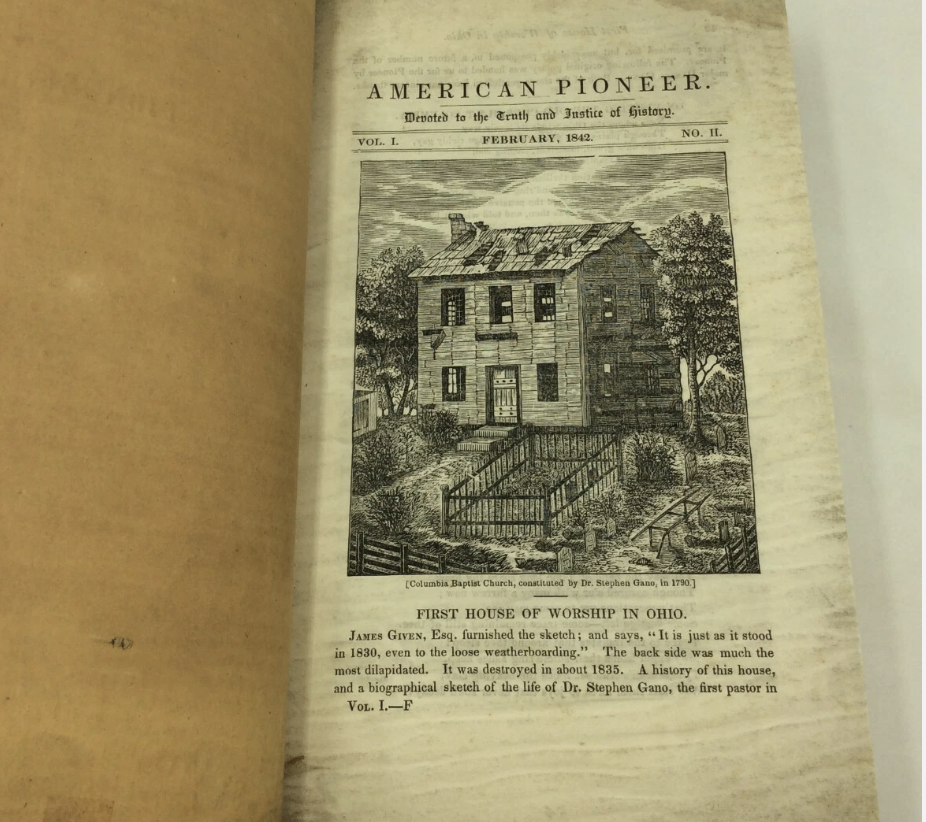
Following below is a letter written by Benjamin Sharp in 1842 to the editor of a history magazine entitled The American Pioneer, and which was published in Cincinnati, Ohio by John S. Williams. The letter was printed in the June 15th issue of that periodical. It tells first hand accounts of the Battles of Long Island Flats at Kingsport, and of the Indian fighting around Black’s Fort in Abingdon, both during the early phases of the Cherokee War that started as a part of the American Revolution. Following the text of the letter will be a summation of what little biographical material exists on Benjamin Sharp, himself.
MR. SHARP’S LETTER
Warren County, Missouri, June 15th, 1842
Dear Sir –
In the year 1776, about the time American independence was declared, all that part of West Virginia now contained in the counties of Wyth, Smyth, Washington, Russell, Lee, and Scott, with the adjoining counties in North Carolina (now Tennessee) of Sullivan and Washington, were broken up and the inhabitants driven into strongholds. About the last of June or the first of July, the traders fled from the Cherokee nation with the alarming news, that the Indians were coming in great force, and in a few days would break into the settlements.
A few of the militia, perhaps one hundred and fifty or two hundred, hastily assembled under the command of captains James Thompson, James Shelby, and William Cook and proceeded to the frontier house, about fifteen miles in advance of the settlement, and begun to build a kind of stockade fort with fence rails; but before they could finish their fort their spies gave them notice that a large Indian force was within a few miles.
It was then debated, which would be the most prudent, to await their coming in their crazy fort or march out boldly and meet them in the woods. The latter proposition prevailed, and before they had proceeded more than five miles, they discovered nine or ten Indians, who threw down their budgets and fled. This threw the men into disorder, curiosity drawing them around the Indian plunder in a crowd; but presently they heard a noise like distant thunder, and looking round they saw the whole Indian force running upon them at full speed – they made a hasty retreat to a rising ground, where they rallied; and the Indians came running up with savage yells, as if intending to rush among them with their tomahawks.
A sharp engagement ensued, lasting from one-half to three-quarters of an hour, when the Indians disappeared, as if by magic, leaving the white men masters of the ground. Of the whites none were killed and only four slightly wounded. Eleven or twelve Indians lay dead upon the field and many trails of blood were found where the dead were carried off or the wounded had escaped. My oldest brother and a brother-in-law were in the action.
A curious incident occurred during the engagement. An Alexander Moore, a strong, athletic, active man, by some means got into close contact with an Indian of nearly his own size and strength; my brother-ion-law, William King, seeing Moore’s situation, ran up to his relief, but the Indian adroitly kept Moore in such a position that King could not shoot him without shooting Moore. The Indian had a large knife suspended at his belt, for the possession of which they both struggled, but at length Moore succeeded and plunged it into the Indian’s bowels; he then broke his hold and sprung off from Moore, and King shot him through the head.
The victorious party now returned to the fort, and instantly dispersed to take care of their own families and concerns. In the meantime the whole settlements were breaking up and the people fleeing from every quarter. We had collected some horses and loaded them with such necessaries as we could hastily pack up, and about the middle of the day my father, an old man, set off with them and the females of the family to seek a place of safety, he know not where.
I was dispatched on foot to accelerate the escape of a brother’s and sister’s families, the one living four and the other six miles directly toward the point of danger. I was a little turned of fourteen years of age; the day was warm, but I was light and active and had no encumbrance but my gun and shot-pouch, and I traveled rapidly.
On my arrival I found the families had fled, and I turned to pursue my father. I had twelve miles to go to gain the great road, which I did as the day was nearly closing. In my whole route I not seen a human face, but here the road was full of people moving hastily along; they were all strangers to me, but learning my situation one man generously proposed to carry me behind him till I could regain my friends or hear some intelligence of them.
This offer I gladly embraced, and after some time we came to the farm of a captain Joseph Black, where Abington now stands, where we found four or five hundred souls of all descriptions collected together to build a fort, and here I found my connections.
The next day, when all hands were engaged in procuring materials and building fort Black, we received the news of the battle of long Island, which gave us much encouragement, and business was suspended till a prayer of thanksgiving was offered up by the Rev. Charles Cummings, a Presbyterian minister.
Not more than two or three days after this a captain James Montgomery, who lived about eight miles off, came to the fort; he had concluded, with two other families, to defend his own house, but not knowing what was going on he had rode out to try to find some people or get some intelligence. He was earnestly beset to bring the families instantly to the fort, and men and horses were sent to assist him.
They soon returned with the families and some of their effects, and went back for more, but to their surprise they found the houses plundered and all in flames. They retreated hastily to the fort, and spies were appointed and sent out – but for several days they made no discovery, but at length they came in one night after dark and reported that they had discovered afire on the bank of the river above Mongomeies, which they supposed to be the Indian camp.
An express was sent off to another fort, requesting their men to meet our men at a certain place at a certain hour that night. A party set off with the spies and was met by the men from the other fort according to appointment, and the spies conducted them to the spot. They cautiously surrounded them from the river below to the river above them with strict injunctions to preserve a profound silence till the report of the captain’s gun should give the signal for a general discharge, and in this position they waited for day.
As soon as day had fairly dawned the Indians arose and began to move about the camp, when the crack of the captain’s rifle was followed by a well directed fire from every quarter; the Indians fled across the river, exposed all the way to the fire of the whites, if any fell or sunk in the river it was not known, but if I recollect right eleven lay dead at and around the camp.
The men crossed the river and found various trails of blood, one of which they traced up to where the fellow had crept into a hollow log; they drew him out by the feet and found him mortally wounded: he requested them by signs to shoot him in the head, which request they granted.
When the men returned all safe, with the Indian spoils and scalps, there was great rejoicing, and the scalps were suspended to a pole and fixed as a trophy over the fort gate. But we did not enjoy this triumph long, for shortly after a different scene took place.
One morning three parties prepared to go out; one in which were my father, my two brothers, and two brothers-in-law, went early and was unmolested, they went to visit some plantations twelve miles off, and knew of nothing that had happened behind them, and did not return till late at night.
Of the other two, one went to a field about a mile off, I think to secure some flax, and the other about the same distance to the house of the Rev. Charles Cummings, to bring his books, and some of his effects to the fort. Both these parties were attacked at the same time in full hearing of the fort; and here an undescribable scene of disorder took place, the women and children screaming, wives clinging to their husbands, mothers to their sons, and sisters to their brothers, to prevent them from going out, and crowding the fort gate, so that the men could hardly pass or repass.
However a number of the men broke through, and ran to the rescue as fast as possible, but before they could arrive the Indians had done their work and were gone; one man was killed and one wounded in each party. A man by the name of Blackburn, was shot, tomahawked, and scalped, and yet was found alive, brought in, and recovered of his wounds. He was a long time an object of compassion.
The gallantry of two young men in this affray deserves to be recorded here. William Casey had a sister, a beautiful little girl, about sixteen years of age, along with the party at the field; and as he was running for his life, discovered the Indians in close pursuit of his sister; and at that moment his eyes falling upon another young man, by the name of Robert Hasold, he called to him to come and help him to save Nancy.
Hasold obeyed, and although there were four or five Indians in pursuit, (some said seven,) they rushed between them and the girl, and by dexterously managing to fire alternately, still keeping one gun loaded when the other was discharged, they kept the Indians at bay till they gave up the pursuit, and they brought the girl in safe. Such acts of generous bravery ought at all times be held up as examples to our youth. Ever after, these two young men stood prominent in society.
During the summer several murders were committed; two men were killed almost in sight of the neighboring fort, who had gone out to bring in their horses. Of two men who went with an express from fort Black, one was killed and the other made his escape.
It had been early determined to carry an expedition into the Indian country: and troops begun to assemble at the long Island, the place of rendezvous, and build a fort, which was called fort Henry. A company was enrolled at fort Black, and taken under pay, to guard the fort and escort the provision and baggage wagons going to, and returning from the rendezvous. In this company I engaged, which was the first of my military service.
I think some time in November, the army, one thousand five hundred, or two thousand strong, under the command of colonel William Christian, of Virginia, moved on the Indian towns. I cannot recollect that this army killed any Indians, or took any prisoners; but they burned down all their villages, destroyed their corn, and every article of subsistence they could find, which reduced them to such a state of starvation, that before spring they sent in a flag for peace, which resulted in the treaty of the Long Island, in 1777.
I attended this treaty only one day, and that before the conferences begun and can report nothing of my own knowledge; I will only mention an oratorical figure in a speech of the Raven, the principal Indian chief.
A great many Indians with their squaws and children had collected, and were quartered in the island, surrounded by a guard to prevent improper intercourse with the whites; but notwithstanding this precaution, some abandoned fellow shot across the river and killed an Indian. This produced great confusion; the Indians thought they were betrayed, and prepared to fly, and it was with much exertion the officers and commissioners could convince and pacify them.
Afterwards when the council met, the Raven opened the conference on the part of his people by a speech, in which he reverted to the case of the murdered Indian. He said, least that unhappy affair should disturb the harmony and sincerity that ought to exist at that time between the white and red brethren, each party ought to view it as having happened so long ago, as if when the Indian was buried an acorn had been thrown into his grave, which had sprouted and grown, and become a lofty spreading oak, sufficiently large for them to sit under its shade, and hold their talk.
This speech was much talked of at the time, and many thought it equal to any thing in the celebrated speech of Logan. Thus ended the first Cherokee war.
I am, with much esteem &c.
Benj. Sharp
Biography
Benjamin Sharp is a phantom of our regional past, a sense of whose importance to our heritage needs to be regained. The only widely known reference to him in our historic literature is his cryptic commentary on the death of Chief Bob Benge recorded in Summer’s History Southwest Virginia and of Washington Co. and in the author’s Benge!
Benjamin was born in Lancaster County Pennsylvania on January 23, 1763. He was the son of John Sharp, who was born in Scotland about 1720, and who died in Sullivan County Tennessee July 1796. John’s home, where Benjamin was raised, was on the South Fork of Holston River, a few miles above the present dam.
Benjamin acquired excellent social and business contacts by his and his family’s’ marriages. He married Hannah Fulkerson, who was the daughter of James Fulkerson, and the niece of Abraham and sister of Peter Fulkerson. Her mother was Mary Vanhook, whom his father had married when this assortment of families were living in North Carolina.
The Fulkersons were Dutch Huguenots, and were part of that group that migrated across America to finally settle in Washington County, Virginia, after having first settled in Elk Garden, Russell County. Other clan names that were in that group of wandering Huguenots were the Dyes and the Vanhooks.
The Fulkersons were high up in the social structure of Washington Co, and Abraham became a Colonel in the Holston Militia, a rank usually reserved for the Scots-Irish. The Fulkersons seemed to serve as intermediaries between the Scots-Irish community and the sizable German one. As a ranking officer in the Holston Militia, Abraham had been a special target of Chief Benge on his last raid in 1794, when Benge sought to attack Abraham’s house near Hiltons, Va.
The Fulkersons were aggressive and prosperous land speculators in Washington, Scott, and Lee Counties, Virginia. Benjamin would profit much from this connection.
Benjamin was also the brother-in-law of one of the several William Kings, whose family is connected with the salt works at Saltville, King College, Kingsport, and Steel Creek in Bristol. They were easily the wealthiest family in the region at that time.
Early records of Benjamin’s activities in the Holston Valley are sketchy. He got a land grant in Elk Garden amongst his wife’s relatives, he got land on Beaver Creek, and moved to the Mendota Community on the North Fork, according to the historian Goodpasture. This made him neighbors with the Livingstons, Benhams, and the Hobbs, all of whom were to be swept up in the infamous last raid of Chief Benge.
Virginia made money in two ways off of its land sales on the frontier. First of all, it issued land warrants which entitled the holder to claim a specified acreage of unpatented land. These warrants were traded for cash on the secondary market. Then, of course, the Virginia Land Office charged a fee for the land itself, after the purchaser had presented a warrant and a survey of his claim. The land could, then, be sold on the secondary market. The Fulkersons were aggressive traders of both Land Warrants and of Land.
About 1790 several families from the Mendota community moved to Turkey Cove (Dryden) in Lee County. Their motives involved land speculation, hunting, and community defensive needs. The Cherokee War had raged in sanguine passion since 1776, and in 1777 the Cherokee had run all the settlers out of Lee County save for the eastern most garrison at Rocky Station.
Late in that war the Holston Militia decided to deploy a rapid deployment force of rangers at Yoakum’s Station in Turkey Cove. Among those settlers of the Mendota Community that relocated to Dryden were the brothers Absolum and Vincent Hobbs, Jr, and likely Vincent Hobbs, Sr., John Benham, and Benjamin Sharp, who bought 620 acres as the assignee of his brother-in-law Peter Fulkerson. The land was next to Absolum Hobbs.
This started a process that was oft repeated. He either bought warrants or the land itself from Peter Fulkerson, all through Lee County. The land was spread throughout the county, and often was the less desirable left overs after wealthier speculators had gotten the cream. Before the process was over he had acquired 2,622 acres in Lee County in his own right, and was part owner of 1,083 more. He also bought 273 acres on the North Fork of the Clinch near Duffield in Scott County.
He followed the common pattern of that era, and sold his Lee County holdings so that he could reinvest his profits in land further west, and wound up dying in Warren County, Missouri on January 1, 1844.
His only claim to lasting fame is his commentary on the actions of the Yoakum’s Station Militia in the killing of Chief Bob Benge in Wise County in 1794. That party was composed of his neighbors Absolum and Vincent Hobbs, Jr., and James Huff and others of the Turkey Cove community. His narrative is written with such authority that one could think that he was one of the members of that party whose name James Huff could not remember half a century later, when he told of that event to a Louisville Newspaper.
Sharp’s narrative of the Benge killing is rumored to be somewhere in the same periodical that this letter of his was published in. The American Pioneer is on microfilm at Alderman Library at the University of Virginia, the source of this narrative. Perhaps someday someone will be able to locate it. In the meantime, this article will serve to restore the memory of Benjamin Sharp to its rightful place in local history.
Special thanks to Dale Carter for his help on this article, and to the Lonesome Pine Regional Library for its help in procuring a photocopy of the microfilmed Sharp document.